
MISC – STINGRAY BLACK DIAMOND / LEOPOLDI
Potamotrygon leopoldi
$799.99
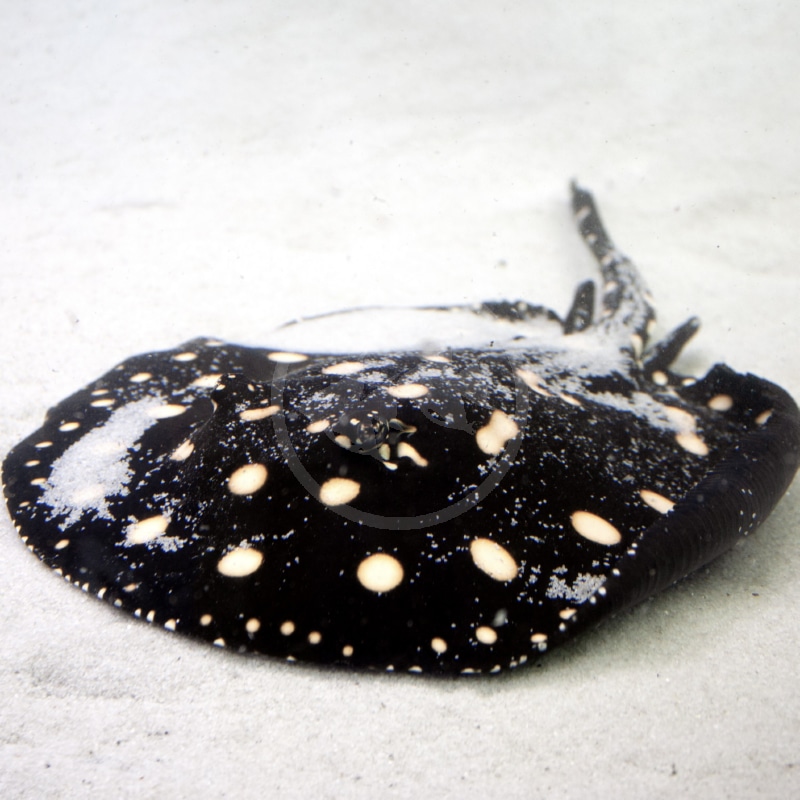
The Black Diamond Stingray, also known as the Leopoldi Stingray, Polka-dot Stingray, Xingu River Stingray, are one of the most striking stingray species within the aquarium trade. Found only in the Xingu River basin in Brazil, the Black diamond stingray occupy a number of biotopes including flooded forests during the annual wet season, and sand or mud banks of slow moving tributaries and shallow waters of major river systems. The disc of a Black diamond stingray is black with many large yellow-white spots. Male stingrays can be easily distinguished from females by the “pointed” appendages, called claspers, on each pelvic fin. Best viewed ventrally, the claspers transfer sperm from the male to the female during spawning. Breeding stingrays is not easy, and the juvenile specimens typically offered take years to reach sexual maturity. Wild specimens are almost, if not entirely, obsolete from the hobby due to highly strict national restrictions from Brazil and CITES regulations that protect the species. The few that are produced on a commerical fishery basis (i.e., aquaculture or tank-raised) boast a price tag to reflect their rarity in the hobby. Like other freshwater rays, Black diamond stringrays require exceptional dedication and attention that is best left to more of an expert hobbyist. Things that cannot be overlooked with this species include aquarium size, proper diet and water quality/filtration (see ‘Diet’ and ‘Care Requirements’ below). A Black diamond stingray can be kept solitary or as a male with a female, though males can be quite aggressive toward females when they want to spawn. In this setting, the female should be much larger in size than the male so that she can hold her ground better. Males should not be kept together as they can be violent with each other. We do not recommend mixing a Black diamond stingray with any other Potamotrygon stingray because hybridization has been commonly reported. Hybridization is the process by which two species breed and create offspring that then have 1/2 of the genetic material from each parental species. While this may seem cool to do, it causes genetic defects in the offspring that can come with additional health or anatomical complications down the road. An adult Black diamond stingray’s disc can reach a size of approximately 42″ across in the wild, but 24″ across is more common in the home aquarium. Venomous Note: Freshwater stingrays, including the Black diamond stingray, have a visible stinging spine located on the top of their caudal fin. This spine is surrounded by an integumentary sheath that protects the spine and the venom glands. Stingrays shed this spine about every three to six months and form a new one. This detached spine can still hold venom for a period of time, so extreme caution should be exercised when performing tank maintenance. The toxicity of venom varies among stingrays, but if you are stung, immediately run the affected area under very hot water as to denature, or breakdown, the venom proteins. Seek additional medical attention as needed. Most stings are the result of an accident. Stingrays do not strike with malice, as their stingers are for self-defense. Many Black diamond stingrays become rather personable and friendly with their owners, but it is up to the hobbyist to ensure their space is respected.
Out of stock
*We cannot ship Black Diamond Stingrays to the states of Arizona, Arkansas, California, Florida, Georgia, Hawaii, Mississippi, Nevada, Oklahoma, Texas, or Utah.
Care Level: Advanced
Temperament: Peaceful
Live Plant Safe: No
General Description: The Black Diamond Stingray, also known as the Leopoldi Stingray, Polka-dot Stingray, Xingu River Stingray, are one of the most striking stingray species within the aquarium trade. Found only in the Xingu River basin in Brazil, the Black diamond stingray occupy a number of biotopes including flooded forests during the annual wet season, and sand or mud banks of slow moving tributaries and shallow waters of major river systems. The disc of a Black diamond stingray is black with many large yellow-white spots. Male stingrays can be easily distinguished from females by the “pointed” appendages, called claspers, on each pelvic fin. Best viewed ventrally, the claspers transfer sperm from the male to the female during spawning. Breeding stingrays is not easy, and the juvenile specimens typically offered take years to reach sexual maturity. Wild specimens are almost, if not entirely, obsolete from the hobby due to highly strict national restrictions from Brazil and CITES regulations that protect the species. The few that are produced on a commerical fishery basis (i.e., aquaculture or tank-raised) boast a price tag to reflect their rarity in the hobby. Like other freshwater rays, Black diamond stringrays require exceptional dedication and attention that is best left to more of an expert hobbyist. Things that cannot be overlooked with this species include aquarium size, proper diet and water quality/filtration (see ‘Diet’ and ‘Care Requirements’ below). A Black diamond stingray can be kept solitary or as a male with a female, though males can be quite aggressive toward females when they want to spawn. In this setting, the female should be much larger in size than the male so that she can hold her ground better. Males should not be kept together as they can be violent with each other. We do not recommend mixing a Black diamond stingray with any other Potamotrygon stingray because hybridization has been commonly reported. Hybridization is the process by which two species breed and create offspring that then have 1/2 of the genetic material from each parental species. While this may seem cool to do, it causes genetic defects in the offspring that can come with additional health or anatomical complications down the road. An adult Black diamond stingray’s disc can reach a size of approximately 42″ across in the wild, but 24″ across is more common in the home aquarium. Venomous Note: Freshwater stingrays, including the Black diamond stingray, have a visible stinging spine located on the top of their caudal fin. This spine is surrounded by an integumentary sheath that protects the spine and the venom glands. Stingrays shed this spine about every three to six months and form a new one. This detached spine can still hold venom for a period of time, so extreme caution should be exercised when performing tank maintenance. The toxicity of venom varies among stingrays, but if you are stung, immediately run the affected area under very hot water as to denature, or breakdown, the venom proteins. Seek additional medical attention as needed. Most stings are the result of an accident. Stingrays do not strike with malice, as their stingers are for self-defense. Many Black diamond stingrays become rather personable and friendly with their owners, but it is up to the hobbyist to ensure their space is respected.
Diet Requirements: Black diamond stingrays are carnivores and are one of the top predators of their natural ecosystems in the wild. Given that all Black diamond stingrays are aquacultured, they will usually more readily accept prepared foods. Stingrays are very active with high metabolisms and it takes a great deal of food to keep even a single individual in good health. Food options will change with the size of your Black diamond stingray, but a diet made up of various high quality protein based frozen foods are ideal. These include, but are not limited to, bloodworms, mysis shrimp, krill, chopped clam, squid, mussels, brine shrimp, and silverside fish. Fresh or frozen pieces of whitefish fillets from the grocery store are also acceptable for large specimens. Certain freeze-dried foods such as Tubifex worms may also be accepted. Live blackworms or ghost shrimp are a fun occasional treat. Variety is the spice of life in order to maintain color, immune function and longevity of your stingray. We discourage feeding live fish to Black diamond stingrays because they are often of little nutritional value and increase the risk of introducing disease. Do not feed your Black diamond stingray mammalian or avian meats from the store. Note: While we strive to offer stingrays that are eating strictly frozen foods, or a combination of frozen foods and live blackworms, it is not uncommon for your Black diamond stingray to ignore food altogether for a period of time due to the stress of a new environment.
Care Requirements: An extremely established minimum 250 to 300 gallon aquarium is ideal for a single Black diamond stingray. A pair will require additional space upwards of 450 gallons or more. Juvenile specimens could be temporarily raised in a smaller tank, but nothing less than 90 to 120 gallons should be considered. The dimensions of an aquarium are particularly important for stingrays given their large adult size. The width of the aquarium should be no less than 36″, and the length of the aquarium 90″+. A tight fitting lid is required as most stingrays will come right up to the surface of the aquarium, especially as they become more settled in. Black diamond stingrays should not be introduced into a biologically immature aquarium as they are extremely sensitive to nitrite and ammonia. Large, weekly water changes (40%) are needed to keep water parameters pristine (Nitrates < 20 ppm) from the large amount of waste produced by stingrays. An ideal set-up for a stingray aquarium would be one that includes a sump system. A sump not only contains all of the equipment externally, including a heater in which a stingray could rest on and inadvertently burn themselves, but this type of system makes maintenance of a large aquarium much simpler. If a sump system is not possible, equipping the aquarium with two or more canister filters is the next best solution. The total water volume needs to turnover at least 4 times per hour. Both a sump or canister filtration system can achieve this and provides the ample oxygen needed by a Black diamond stingray. Decor in a stingray tank is really up to the hobbyist. Pieces of driftwood or smooth stones are simple choices that add some aesthetic, but make sure they are secured in place as to not be moved by your stingray. At the very least, a several inch deep fine to sandy substrate bed should be provided. In the wild, stingrays bury themselves when they feel threatened or stressed. While bare bottom tanks are favorable for ease of maintenance, to deny them of the option to bury seems somewhat unfair. Ultimately, ample open swimming space should be the focus of the aquascape. Black diamond stingrays are best kept as a species-only tank because there are few fish in which they are compatible with. Most fish will be seen as prey, may nip your Black diamond stingray, or are too aggressive-territorial. Some success has been reported with certain South American cichlids such as severum, festivum, and geophagus. Silver Arowana (Osteoglossum bicirrhosum) are a common pairing with Black diamond stingrays. Most South American plecostomus species should be avoided because many have been observed latching onto stingrays and causing injury. Care should be taken acclimating a Black diamond stingray; we advise using a drip acclimation method in a large plastic tub. Never use a net to catch or transfer a stingray. This should be done with a plastic container or a large fish bag. Recommended water conditions, 76-84° F, KH 2-10, pH 6.0-6.8.
Purchase Size: (Diameter) Small: 4” to 6”
Note: Your item may not look identical to the image provided due to variation within species. Purchase sizes are approximate.
Dry goods orders are shipped via US Postal Service or UPS to the address provided at checkout based on the selection made in your website shopping cart. Product is carefully packed to help prevent any damage during shipping. Once processed you will receive a shipment notification via email with tracking number, and delivery notification. Please allow 48 hours for processing after your order is placed.
Perishable items (i.e. live plants, refrigerated/frozen foods) are shipped via US Postal Service 2-3 day to the address provided at checkout for a $25.00 flat rate charge. Items are packed with secure packing material and heat, cold, or Cryo packs as needed to maintain safe temperatures during transit. If one or more perishable items are in the shopping cart at checkout the $25.00 perishable shipping charge will automatically appear and need to be selected. Once processed you will receive a shipment notification via email with tracking number. Please allow 48 hours for processing after your order is placed.
Livestock (i.e. fish, invertebrates, coral) are shipped via UPS Overnight to the address provided at checkout for a $55.00 flat rate charge. Livestock is packed in insulated styrofoam boxes with secure packing material and heat, cold, or Cryo packs as needed to maintain safe temperatures during transit. If one or more livestock items are in the shopping cart at checkout the $55.00 livestock shipping charge will automatically appear and need to be selected. Livestock is shipped Monday through Wednesday ONLY (no weekend delivery is available) weather permitting, and we reserve the right to delay shipping until conditions are appropriate for safe arrival. Once your order is placed we will contact you to arrange the best shipping date based on these criteria. Someone must be available to receive the livestock order on the first delivery attempt. Once processed you will receive a shipment notification via email with tracking number. Please allow 48 hours for processing after your order is placed.
For mixed dry goods/perishable & livestock orders items will be shipped via their corresponding shipping methods outlined above. Dry goods will be shipped via US Postal Service or UPS based on your selection and checkout, while livestock will ship via UPS Overnight for a $55.00 flat rate charge. You will receive separate notifications and tracking numbers for the dry goods and livestock. Please note due to different carriers and shipping methods dry goods and livestock may arrive on different days.